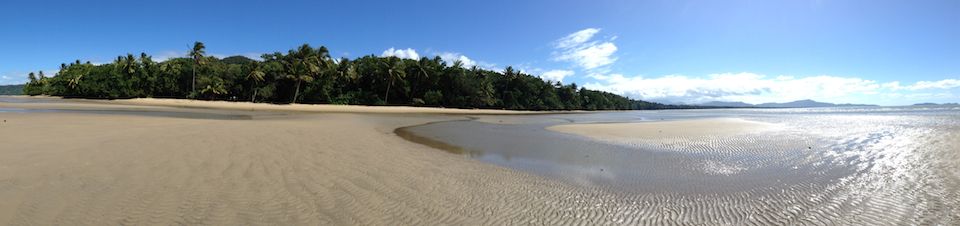
WONGA BEACH WALK. Is on the way to Daintree ( Latitude
South 16 deg 20 min, Longitude East 145 deg 30 min.) at the northern end
of Trinity Bay. Cairns is at the southern end.
It is the only beach in Trinity Bay that you can walk along, without
seeing artifacts, and really experience a wilderness feeling. It has a
beautiful lush back drop of huge Calophyllum trees interspersed with
Coconut palms.
In 1770 Captain Cook named the northern bay's continental Island Snapper
Island and the near-by coral cay Low Isles. A 30 mile light house was
installed on the smaller cay of Low Isles in 1898. Looking south from
Wonga Beach you can see Island Point which shelters the harbour entrance
of Port Douglas. It looks like an island from offshore. The rainforest
clad mountain range to the north is called Alexandra Range after a
Danish princess who married the Prince of Wales.
The rainforest clad mountain range behind Wonga Beach is called Dagmar
Range after Alexandra's younger sister, Dagmar.
She married into the Russian royal family becoming
Empress Marie Fedodorovna. The last three features were named by the
discoverer of Daintree, George Elphingstone Dalrymple, a servant of the
crown. George was careful enough to keep his masters happy by naming
features after them but also considered his fellow mariners following in
his wake. Island Point is a good example.
The two ranges and Wonga Beach form the boundaries of the Daintree
Valley and could rightfully earn Wonga Beach the title Daintree Beach.
The Daintree River, Wonga Beach and the beach end of Alexandra Range
form a natural funnel when the prevailing south-east trade winds are
taken into account and explain why there are no sandflies at Wonga Beach
and there are so many different species of mangroves in the Daintree.
Firstly sandflies cannot operate in that sort of wind and mangrove seeds
float and are taken along the surface of the water by wind and currents.
They collect in the Daintree River estuary and along Wonga Beach because
of this natural funnel effect.
Beachcombing along Wonga has it's rewards with these seeds and other
flotsam which includes pumice originating in the subterranean volcanoes
of the Pacific Ocean. There is a maintained grave along the beach. It
belongs to a maritime hero Charlie Lifu and includes an inscription of
his feats. It is behind the beach near the Close that bears his name.